
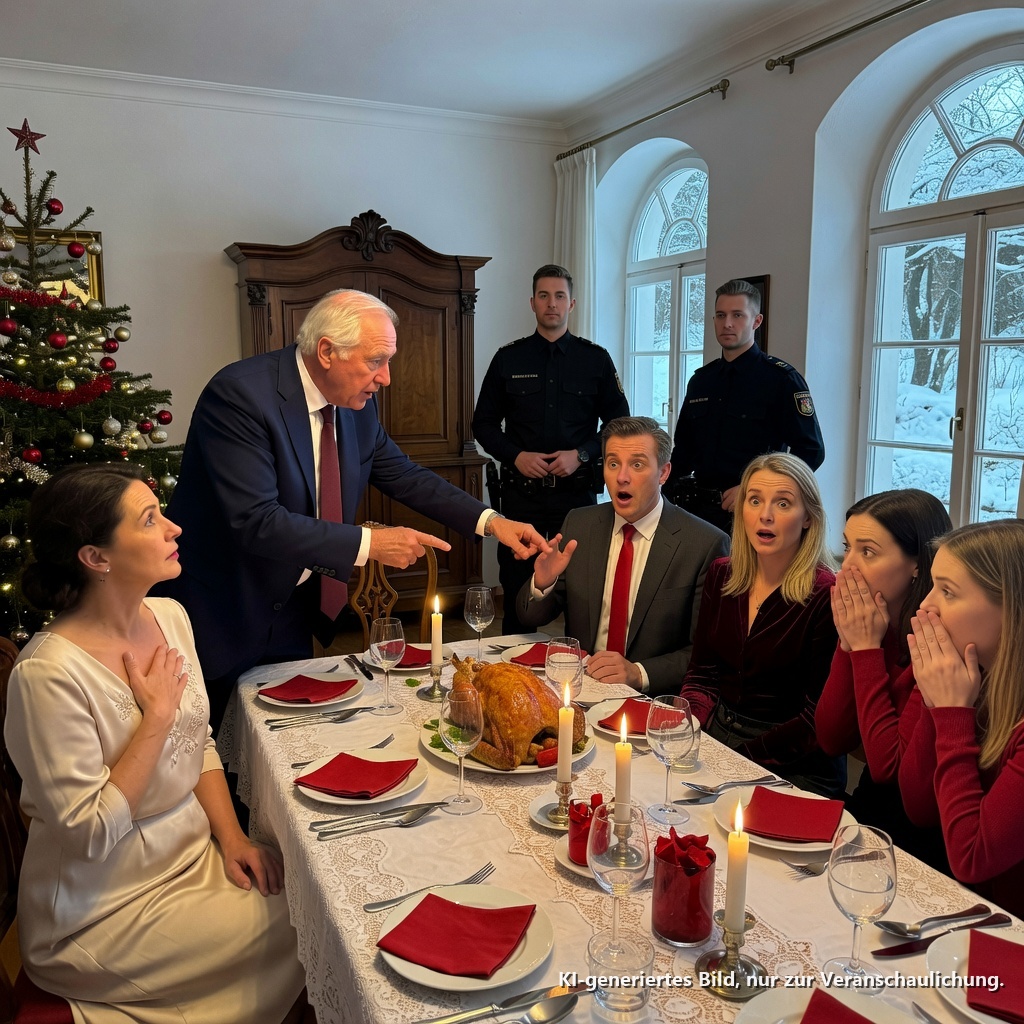
Am Weihnachtsessen schlug mein Großvater auf den Tisch: „Warum kontrolliert ein Fremder das Millionenunternehmen, das ich dir hinterlassen habe?“ Ich erstarrte und sagte dann: „Wovon redest du? Ich habe nicht einen Dollar auf meinem Konto.“ Der Raum wurde still. Meine Eltern und mein Bruder wurden blass. Dann kam die Polizei…
Teil 1
Das Erste, was mir auffiel, als Opa Walter nach Hause kam, war, dass er älter aussah.
Nicht schwach. Niemals schwach. Nur abgenutzt an den Rändern, als hätten die elf Monate, die er mit der Aushandlung von Schifffahrtsverträgen im Ausland verbracht hatte, etwas von ihm abgeschliffen.
Er stand am Weihnachtsnachmittag im Eingangsbereich meiner Eltern, trug einen anthrazitfarbenen Mantel, eine Hand auf einer abgenutzten Lederaktentasche. Kalte Luft folgte ihm durch die Tür und trug den Geruch von Regen und Zedernrauch vom Kamin der Nachbarn herein.
Meine Mutter, Diane, eilte mit offenen Armen auf ihn zu.
„Dad! Du hättest vom Flughafen anrufen sollen.“
Opa nahm ihre Umarmung an, aber sein Blick wanderte über ihre Schulter und fand mich.
„Da ist mein Mädchen.“
Ich lächelte und umarmte ihn vorsichtig. Er roch nach Pfefferminzkaugummi und dem gleichen Sandelholz-Rasierwasser, das er trug, seit ich ein Kind war.
„Du bist uns abhandengekommen“, sagte ich.
„Ich habe gearbeitet.“
„Du arbeitest immer.“
„Du anscheinend auch.“ Sein Blick fiel auf die schwarze Hose und das weiße Catering-Hemd, das ich direkt von meiner Feiertagsschicht anhatte. „Deine Mutter hat mir erzählt, dass du immer noch Zeitarbeitsjobs machst.“
Bevor ich antworten konnte, schob Mom ihren Arm unter seinen.
„Claire ist auf der Suche nach sich selbst.“
Sie sagte es leicht, aber die Worte landeten wie eine vertraute Ohrfeige.
Auf der Suche nach sich selbst.
So beschrieb meine Familie die vier Jahre seit meinem Abschluss an der University of Houston mit einem Abschluss in Supply Chain Management. Sie erwähnten nie die Dutzenden von Jobs, auf die ich mich beworben hatte, die Vorstellungsgespräche, die vielversprechend schienen, bis Personalvermittler plötzlich nicht mehr antworteten, oder die Lagerposition, die ich verloren hatte, nachdem eine anonyme Beschwerde mich beschuldigte, meinen Lebenslauf gefälscht zu haben.
Mein jüngerer Bruder, Mason, kam aus dem Esszimmer mit einem Glas Bourbon in der Hand.
„Opa, du hast es geschafft.“
Mason trug einen neuen marineblauen Pullover, eine teure Uhr und den zufriedenen Ausdruck von jemandem, der sich nie fragen musste, ob seine Debitkarte an einer Tankstelle abgelehnt würde.
Seine Frau, Brooke, erschien hinter ihm in einem cremefarbenen Kleid. Sie küsste Opas Wange und begann sofort, die Renovierung zu beschreiben, die sie an ihrem Masterbad abgeschlossen hatten.
Ich stand neben dem Garderobenschrank und hielt immer noch die Leinentasche mit meinen Arbeitsschuhen.
Niemand fragte nach meiner Wohnung, meinem zweiten Job oder dem Auto, das jedes Mal ein knirschendes Geräusch machte, wenn ich links abbog.
Das war normal.
Das Abendessen begann um sieben.
Mom hatte das Esszimmer so dekoriert, als ob ein Magazinfotograf jeden Moment eintreffen könnte. Kieferngirlanden umrahmten die Fenster. Rote Kerzen brannten in Messinghaltern. Ihr antikes Porzellan spiegelte die blinkenden Lichter des Weihnachtsbaums im angrenzenden Zimmer wider.
Opa saß am Kopfende des Tisches.
Dad saß zu seiner Rechten und schnitt den Truthahn mit langsamen, präzisen Bewegungen. Mason und Brooke saßen mir gegenüber und flüsterten miteinander, wann immer Mom sich in Richtung Küche wandte.
Zwanzig Minuten lang benahm sich jeder perfekt.
Dad sprach über seine Baufirma.
Mason erörterte eine Immobilienmöglichkeit.
Mom beschwerte sich über die Weihnachtsbeleuchtung eines Nachbarn.
Ich konzentrierte mich auf die Rosmarinkartoffeln und versuchte, nicht an die überfällige Stromrechnung zu denken, die in meiner Handtasche zusammengefaltet war.
Dann hörte Opa auf zu essen.
Er legte seine Gabel neben seinen Teller und sah Dad direkt an.
„Wer ist Grant Holloway?“
Das Tranchiermesser hielt mitten im Truthahn inne.
Dad blinzelte. „Wie bitte?“
„Grant Holloway.“
„Ich kenne den Namen nicht.“
Opas Blick wanderte zu Mason.
Mein Bruder hob seinen Bourbon. „Sollte ich?“
Opa antwortete nicht.
————————————————————————————————————————
At the Christmas dinner, my grandfather slammed his fist on the table: “Why is a stranger controlling the million-dollar company I left you?” I froze, then said, “What are you talking about? I don’t have a dollar in my account.” The room went silent. My parents and brother turned pale. Then the police arrived…
Part 1
The first thing I noticed when Grandpa Walter came home was that he looked older.
Not weak. Never weak. Just worn at the edges, as if the eleven months he’d spent negotiating shipping contracts abroad had sanded something off him.
He stood in my parents’ entryway on Christmas afternoon, wearing a charcoal coat, one hand resting on a worn leather briefcase. Cold air followed him through the door, carrying the smell of rain and cedar smoke from the neighbor’s fireplace.
My mother, Diane, rushed toward him with open arms.
“Dad! You should have called from the airport.”
Grandpa accepted her hug, but his gaze traveled over her shoulder and found me.
“There’s my girl.”
I smiled and hugged him carefully. He smelled of peppermint gum and the same sandalwood aftershave he’d worn since I was a child.
“You’ve been gone,” I said.
“I’ve been working.”
“You’re always working.”
“You apparently are too.” His eyes fell on the black pants and white catering shirt I was wearing straight from my holiday shift. “Your mother told me you’re still doing temp work.”
Before I could answer, Mom slipped her arm under his.
“Claire is finding herself.”
She said it lightly, but the words landed like a familiar slap.
Finding herself.
That’s how my family described the four years since I graduated from the University of Houston with a degree in Supply Chain Management. They never mentioned the dozens of jobs I’d applied for, the interviews that seemed promising until recruiters suddenly stopped responding, or the warehouse position I lost after an anonymous complaint accused me of falsifying my resume.
My younger brother, Mason, came from the dining room carrying a glass of bourbon.
“Grandpa, you made it.”
Mason wore a new navy sweater, an expensive watch, and the satisfied expression of someone who never had to wonder if his debit card would be declined at a gas station.
His wife, Brooke, appeared behind him in a cream-colored dress. She kissed Grandpa’s cheek and immediately began describing the renovation they’d completed on their master bathroom.
I stood by the coat closet, still holding the canvas bag with my work shoes.
No one asked about my apartment, my second job, or the car that made a grinding noise every time I turned left.
That was normal.
Dinner started at seven.
Mom had decorated the dining room as if a magazine photographer might arrive at any moment. Pine garlands framed the windows. Red candles burned in brass holders. Her antique china reflected the blinking lights of the Christmas tree in the adjoining room.
Grandpa sat at the head of the table.
Dad sat to his right, carving the turkey with slow, precise movements. Mason and Brooke sat across from me, whispering to each other whenever Mom turned toward the kitchen.
For twenty minutes, everyone behaved perfectly.
Dad talked about his construction company.
Mason discussed a real estate opportunity.
Mom complained about a neighbor’s Christmas lights.
I focused on the rosemary potatoes and tried not to think about the overdue electricity bill folded in my purse.
Then Grandpa stopped eating.
He placed his fork beside his plate and looked directly at Dad.
“Who is Grant Holloway?”
The carving knife paused mid-turkey.
Dad blinked. “Excuse me?”
“Grant Holloway.”
“I don’t know the name.”
Grandpa’s gaze moved to Mason.
My brother raised his bourbon. “Should I?”
Grandpa didn’t answer.
He reached under the table, lifted his leather briefcase, and set it beside his chair.
The brass clasps clicked open.
Mom’s smile stiffened.
“Dad, whatever business problem is on your mind, can it wait? You just got home.”
Grandpa pulled out a thick folder but kept it closed under his palm.
“No.”
That single word changed the temperature in the room.
Dad kept carving, though the blade now made a faint scraping sound against the platter.
Grandpa looked at each of us in turn. When his gaze rested on me, something in his expression softened.
Then his palm hit the table.
Wine jumped in the glasses. Brooke gasped. One of the red candles tipped sideways before Mason caught it.
Grandpa’s voice came low and sharp.
“Why is a stranger controlling the multi-million dollar cold storage company I bought four years ago and put in Claire’s name?”
I forgot to breathe.
The refrigerator hummed in the kitchen. Rain pattered against the windows. Somewhere in the living room, Bing Crosby kept singing about a white Christmas.
I slowly lowered my fork.
“What company?”
Grandpa’s face changed.
I looked around the table, waiting for someone to laugh or explain.
No one did.
“I don’t own anything,” I said. “I have eighty-three dollars in my checking account.”
Dad’s fingers tightened around the carving knife.
Mom’s face went waxy pale.
Mason looked at Brooke, and the glance that passed between them lasted less than a second.
But I saw it.
Grandpa did too.
Before anyone could speak, headlights swept across the dining room wall. A car door closed outside, followed by another.
Then someone knocked three times at the front door.
Through the frosted glass, I could see the unmistakable outlines of two uniformed police officers.
Part 2
No one moved.
The knock came again, louder this time.
Mom pushed her chair back so fast its legs squealed against the hardwood.
“Who calls the police on Christmas?”
Grandpa placed a hand on the closed folder.
“I did.”
Dad set down the carving knife.
The metal hit the platter with a clean, bright sound.
“Walter,” he said carefully, “before you turn a misunderstanding into a public spectacle, maybe you should let us explain.”
“I’ve been waiting four weeks for an explanation.”
Mom stared at him. “Four weeks?”
Grandpa nodded toward the front door. “Let them in, Diane.”
She hesitated long enough to show she was afraid.
Then she walked out of the dining room.
I stayed in my chair, my palms damp against the linen napkin. The sentence repeated in my head.
A company in my name.
No savings account. No small stock portfolio. A multi-million dollar cold storage company.
Four years ago, I’d graduated believing my grandfather’s gift to me was the silver fountain pen he’d presented after the ceremony. My parents had taken photos while I held the velvet box. Mason had joked that Grandpa should have bought me a car instead.
No one had mentioned a company.
Two officers followed Mom into the dining room. The older one introduced himself as Detective Nolan Price. His partner, Officer Ramirez, carried a slim evidence case and had the watchful expression of someone entering a room where every person could be lying.
Detective Price turned to Grandpa.
“We’re here as requested, Mr. Whitmore. We won’t interfere unless you ask us to, but we’ll observe and take custody of any materials related to the complaint.”
“What complaint?” Mason demanded.
Grandpa finally opened the folder.
He pulled out a stack of documents and slid the first page into the center of the table.
A company name appeared at the top:
Red River Cold Storage and Logistics, LLC.
Below it, an address in Texas, outside Dallas.
Grandpa tapped a blunt finger on a highlighted section.
“Grant Holloway is listed as the controlling owner.”
Mason leaned forward.
His face reddened as he scanned the page.
“That must be a different company.”
“It has the same registration number,” Grandpa said.
“Then the state made a mistake.”
“Did the state also invent the warehouses?”
Mason’s lips parted.
Grandpa produced another page. It showed three facilities, a fleet of refrigerated trucks, and contracts with grocery distributors across Texas.
Brooke began tearing her dinner roll into tiny pieces.
Mom moved behind Grandpa and placed a hand on his shoulder.
“You flew halfway around the world yesterday. You’re exhausted. Documents can be misread when you’re tired.”
Grandpa looked at her hand until she removed it.
Dad cleared his throat.
“No one is accusing you of imagining things. But Christmas dinner isn’t the right setting for a corporate investigation.”
I heard myself laugh.
It was a small, broken sound.
Five faces turned to me.
“You’re worried about the setting?” I asked. “Grandpa just said someone sold a company that belonged to me.”
“No one said it was sold,” Dad answered quickly.
“Then why is a stranger controlling it?”
His expression hardened.
“You don’t understand how corporate structures work.”
“I understand ownership.”
“Oh, really?”
The contempt in those two words was so familiar it almost comforted me.
Dad had used that tone when I told him I wanted to study logistics. Mom had used it when I considered moving to Chicago for an internship. Mason had used it whenever I questioned why opportunities seemed to evaporate after I told the family about them.
Grandpa turned to me.
“Claire, has anyone ever asked you to sign documents regarding Red River?”
“No.”
“Have you authorized your parents or your brother to make decisions on your behalf?”
“No.”
Mom pressed a hand to her chest.
“You signed plenty of paperwork after graduation. Insurance forms, tax documents, student loan forms—”
“I didn’t have student loans. Grandpa paid for my education.”
“Then employment contracts. Bank forms. You were overwhelmed.”
“I remember what I signed.”
Mason pushed the company documents away.
“This is ridiculous. A filing error doesn’t mean someone committed a crime.”
Detective Price spoke for the first time since entering.
“Mr. Whitmore’s complaint involves more than a filing error.”
The room went still again.
Grandpa produced a tax document and turned it toward me. The company had reported millions in revenue during the same years I’d been rationing groceries and working double shifts.
My throat tightened.
“Why didn’t you tell me?” I asked Grandpa.
“I believed your father had delivered the transfer documents and introduced you to the management team.”
Dad’s jaw tightened.
Grandpa looked at him.
“That’s what you told me.”
Dad opened his mouth, but Mom answered first.
“We were protecting her.”
The words came out in a whisper.
I turned slowly.
“From what?”
Mom’s eyes filled with tears so quickly it seemed rehearsed.
“From losing everything.”
Then Detective Price opened his evidence case and placed a clear plastic sleeve on the table.
Inside was a document with my name—and a signature that looked almost exactly like mine.
Part 3
The signature fooled me for three seconds.
The capital C was looped, like mine. The final e in Claire curled upward. Even the pressure looked right from where I sat.
Then I noticed the middle initial.
I always wrote the M in one continuous stroke.
On the document, it was formed with two separate lines.
“What is this?” I asked.
“A limited power of attorney,” Detective Price said.
The date was printed next to the signature.
June 18th, four years ago.
I remembered that day because I’d been in Austin for a job interview as a transportation analyst. Mom had called me five times during the drive, warning me that Austin was expensive, dangerous, and too far from home.
I’d slept in a roadside motel after the interview because a thunderstorm had flooded part of the highway.
“I wasn’t in Houston that day.”
Dad reached for the sleeve.
Officer Ramirez moved it out of his reach.
“Copies only,” she said.
Dad’s eyes narrowed. “I’m trying to read it.”
“You can read it from there.”
Grandpa opened another section of his folder.
“Claire’s travel records confirm she was in Austin.”
Mason snorted.
“You can sign something before you travel.”
“The notary stamp says she signed it at four-seventeen that afternoon in Harris County.”
My interview had started at four.
Mom gripped the back of her chair.
“Notaries make mistakes.”
Detective Price nodded. “They do.”
A flicker of hope returned to her face.
“Which,” he continued, “is why we requested the notary journal.”
The hope vanished.
Grandpa slid another page forward.
The journal entry contained my name, a driver’s license number, and a signature. But the identification number belonged to a license I’d lost two months before the stated date.
I’d reported it lost.
The replacement in my wallet had a different issue number.
Brooke stared at Mason.
He kept his eyes on the document.
Dad sat up straighter.
“All that proves is that an employee copied outdated information. Walter asked us to oversee the business until Claire had enough experience to run it. That was the arrangement.”
Grandpa’s brow furrowed.
“No. I asked you to introduce her to the managers.”
“You knew she wasn’t ready yet.”
“That wasn’t your decision to make.”
“She was twenty-two.”
“So was I when I started my first trucking company.”
“You were different.”
The insult hit me harder than it should have.
Grandpa noticed.
His voice went colder. “Explain what the temporary oversight involved.”
Dad took a deep breath.
“We kept the contracts running. Paid suppliers. Reinvested profits. Maintained continuity. Claire was struggling to establish herself, and we didn’t want to add pressure.”
I looked at the revenue numbers.
“Red River earned over nine hundred thousand dollars after expenses in the first year.”
Dad’s eyes flashed.
I tapped the page.
“I lived in an apartment where rain came through the kitchen window. Why didn’t anyone tell me?”
Mom came around the table and crouched beside my chair.
Her perfume was too sweet, roses layered over vanilla.
“You were having such a hard time. Every rejection crushed you. Your father and I thought a company would give you an even greater sense of inadequacy.”
I stared at her.
“You thought wealth would hurt my confidence?”
“We thought responsibility would.”
“So you let me believe I was failing.”
“We gave you time to grow.”
“I worked night shifts in inventory while my company made millions.”
Her mouth trembled.
“We never took the money for ourselves.”
Grandpa flipped to another page.
A transfer history showed payments leaving Red River’s operating accounts.
Some went to legitimate suppliers.
Others went to an entity called BKW Consulting.
The initials matched my father’s full name: Benjamin Kenneth Whitmore.
Dad barely glanced at the page.
“Consulting fees. My construction company handled facility maintenance.”
“Did it?” Grandpa asked.
“Of course.”
“Then show us the invoices.”
“They’re archived.”
“Where?”
“In the office.”
“Which office? The one your bank subjected to a financial review last month?”
Dad froze.
Mason’s head snapped toward him.
Mom whispered, “Dad, how could you know that?”
Grandpa leaned back.
“Eleven months, and you all assumed I was too far away to notice. Distance doesn’t make me blind.”
Detective Price pulled a photograph from his case.
It showed the identification label of a commercial printer.
A date was written below it.
“The authorization document was allegedly printed in June,” he said. “This machine was manufactured in September.”
Mason’s bourbon glass stopped halfway to his mouth.
Dad recovered first.
“Documents are reprinted.”
“They are,” the detective agreed. “But notary stamps are applied after printing.”
Brooke stood up suddenly.
Her chair tipped backward and hit the floor.
“I need some air.”
Mason grabbed her wrist.
“Sit down.”
She looked at his hand, then at his face.
Something silent passed between them—fear, warning, or both.
I’d spent years believing my family thought I was weak. Sitting there, watching their stories fall apart, I realized they’d never underestimated me.
They’d needed me to underestimate myself.
Grandpa reached deeper into his folder.
“There’s another matter,” he said.
He placed six printed emails in front of me.
The first was addressed to the recruiter who’d interviewed me in Austin.
The subject line contained my full name.
And the message warned them that hiring me would be a serious mistake.
Part 4
I recognized the company logo immediately.
Harrison Freight Systems had been my best chance after college. The interviewer, a woman named Karen Liu, had walked me through their operations floor and introduced me to the team. Before I left, she told me I was exactly the kind of candidate they needed.
Two days later, she stopped returning my calls.
The email on Grandpa’s table had been sent the morning after my interview.
To Whom It May Concern,
I believe you should know that Claire Whitmore has a history of neglecting responsibility, exaggerating qualifications, and causing conflict in professional environments.
It went on for four more paragraphs.
The writer claimed to be a former supervisor who feared retaliation if their identity were revealed.
My hands went numb.
“That’s not true.”
“I know,” Grandpa said.
There were five more emails.
One had been sent to a distribution company in San Antonio.
Another to a food manufacturer near Corpus Christi.
The third had reached a graduate program I’d applied to for a paid research position.
Every opportunity had vanished without explanation.
I picked up the pages one by one. The paper rustled dryly under my fingers.
“How did you get these?”
“My attorney contacted the employers after we found the ownership records.”
“Why would they keep anonymous emails?”
“Several were attached to your application files.”
Dad leaned forward.
“That has nothing to do with the company.”
Grandpa’s gaze snapped to him.
“It has everything to do with the company. Someone wanted Claire unemployed, dependent, and convinced she was incapable of working in the industry.”
Mom’s tears returned.
“Those are serious accusations.”
“They are serious actions.”
Mason stood and began pacing beside the Christmas tree. The colored lights flickered across his face, green and red sliding over his tense jaw.
“Anyone could have written those.”
Detective Price pointed to a line of technical information printed across the top of the messages.
“The temporary accounts were routed through several services. But the original sessions started from the same private internet address.”
He looked around the dining room.
“This house.”
Brooke covered her mouth.
Mom sank into the chair beside me.
“That doesn’t prove who typed them.”
“No,” Detective Price said. “Not on its own.”
Mason turned to her.
“Why are you looking at me?”
“I didn’t say anything,” Mom replied.
“You’re acting like this was my idea.”
Dad raised both hands. “Stop.”
Brooke stepped away from Mason.
Her voice came out thin. “You told me your mother wrote them.”
Mason’s face changed.
I looked at him.
“What?”
Brooke wrapped her arms around herself.
“Two years ago, I found a draft on our laptop. Mason said Diane asked him to clean up the wording.”
Mom stood up.
“That’s not how it happened.”
“You told me she was unstable,” Brooke said to Mason. “You said the family was trying to protect her from making rash decisions.”
I could hear my pulse in my ears.
“What rash decisions?”
No one answered.
I turned to Mom.
“Moving to Austin?”
She looked away.
“Taking the job in San Antonio?”
Her lips pressed together.
“Applying for graduate school?”
“We wanted you close,” she whispered.
The honesty was more brutal than any further lie.
“Why?”
“Because families stay together.”
“No. Why did you need me close?”
Dad’s fist hit the table.
“Enough.”
The candles flickered.
He pointed at Grandpa.
“You come home after being gone almost a year and set us against each other over decisions you never had to make. Claire was spiraling. We grounded her.”
“I wasn’t spiraling.”
“You were emotional. Impulsive.”
“I was applying for jobs.”
“In other cities.”
“Because the jobs here kept rejecting me.”
Mason laughed bitterly.
“You never considered that maybe you weren’t as impressive as Grandpa told you.”
Grandpa rose slowly.
The room seemed to shrink around him.
“You will not speak to her that way.”
Mason’s confidence wavered, but only briefly.
“You always favored her.”
“I trusted her.”
“You gave her a company she didn’t even know existed.”
“Because your father promised to complete the transfer properly.”
Dad glared at him. “And we protected it.”
“By forging her signature?”
“Nothing is proven.”
Grandpa turned to Detective Price.
The detective produced a second plastic sleeve.
Inside was an enlarged handwriting comparison. My forged signature appeared on one side. On the other were several signatures from someone else in the room.
The same peculiar break appeared in the middle initial.
The same pressure marks darkened the downward strokes.
Mason stopped pacing.
Brooke stared at him in horror.
Detective Price didn’t accuse him. He simply placed the comparison on the table.
Mason’s voice dropped.
“Handwriting analysis isn’t perfect.”
“No,” the detective said. “But bank statements are usually clearer.”
He placed a bank statement next to the handwriting comparison.
A transfer of 4.8 million dollars had been deposited into an account linked to my parents.
Three days later, nearly half of it had gone to my father’s construction company.
Another payment had been sent directly to Mason.
But the largest transfer had gone to a place none of us expected.
The recipient was Brooke.
Part 5
Brooke stared at the bank statement as if it had crawled onto the table by itself.
“That’s not my account.”
Mason closed his eyes.
Detective Price pointed to the routing information.
“It was opened with your social security number and a copy of your driver’s license.”
“I’ve never seen this.”
“Mason,” I said.
He rubbed his face with both hands.
Dad’s anger shifted immediately.
“You told us the funds were safe.”
“They were.”
“Then why are they in an account under your wife’s name?”
“It was temporary.”
Brooke stepped toward him.
“You used my identity?”
“Don’t make this worse.”
Her face twisted. “I’m making it worse?”
Mom started crying openly.
“We were in an impossible situation.”
The sentence sounded rehearsed, as if they’d repeated it to each other so often it had become permission.
Grandpa remained standing.
“What situation justifies selling property that didn’t belong to you?”
Dad looked at the table instead of him.
“My company was failing.”
I’d known Whitmore Construction was struggling. Dad’s contracts had gotten smaller over the past two years. Trucks disappeared from the lot. Employees who’d come to our childhood birthday parties stopped visiting.
Whenever I asked, Dad said the industry was changing.
Now he told the truth in fragments.
A hospital project had gone over budget. A supplier had filed liens. Two lenders demanded payment in the same month. If Whitmore Construction collapsed, Dad said, forty employees would lose their jobs.
“So you sold Red River,” Grandpa said.
Dad’s mouth thinned.
“We borrowed against it.”
“The records show a sale.”
“We intended to buy it back.”
“With what money?”
Dad had no answer.
Mason dropped into his chair.
“The buyer approached us when the bank was threatening foreclosure.”
“Grant Holloway?” I asked.
Brooke shook her head violently.
“No. I introduced Mason to Grant.”
Everyone looked at her.
She seemed to realize the words had escaped before she could stop them.
“You knew him?” I asked.
“Professionally. His family owns food processing plants.”
Mason reached for her again. She stepped back.
“He said he was looking for cold storage facilities,” Brooke continued. “Mason asked me to arrange a meeting. He told me your grandfather had approved the sale.”
Grandpa’s expression went almost blank.
“I did not.”
Brooke looked sick.
“I didn’t know about Claire.”
“You were at my graduation party,” I said. “You knew Grandpa gave me something.”
“I thought it was money in a trust.”
“You accepted a seven-hundred-thousand-dollar transfer.”
“I didn’t accept anything.”
Detective Price tapped the bank statement.
“That account paid off your house.”
Brooke went completely still.
Her home had been purchased eighteen months ago. Five bedrooms. A pool. White quartz countertops that Mom described to anyone who would listen.
Mason had claimed a successful real estate investment covered the down payment.
Brooke turned to him.
“You told me the money came from a warehouse deal.”
“It did.”
“You said it was your warehouse.”
“It was family property.”
“It belonged to Claire.”
He hit the back of a chair with his hand.
“She didn’t even know it existed!”
The words echoed through the room.
Mason’s face went pale as he heard himself.
I stood up.
My knees shook, but I forced them straight.
“So it was yours?”
“You weren’t using it.”
“I wasn’t allowed to use it.”
“We kept it running.”
“You sold it.”
“To save Dad’s company.”
“And buy your house.”
“That was part of the restructuring.”
I laughed again. This time there was no shock in it.
Only disgust.
Mom reached for me.
“Claire, please listen. We never wanted you to suffer.”
I stepped back.
“You watched me suffer.”
“We thought the company would be returned before you found out.”
“When?”
No one answered.
“When Dad’s failed business magically produced five million dollars? When Mason sold the house? When Brooke returned money she didn’t know she had?”
Mom’s shoulders shook.
“We believed in your father.”
“You believed I would stay poor and quiet.”
“No.”
“You sabotaged my interviews.”
Her silence became a confession.
Grandpa sat back down, but his posture remained rigid.
“You did more than steal a company,” he said. “You built a cage around her.”
Dad’s face hardened.
“Everything we did was for this family.”
Grandpa reached into his briefcase again.
“That excuse won’t protect you from what comes next.”
He placed a notarized legal document in the center of the table.
At the top were the words Last Will and Testament of Walter James Whitmore.
Mom’s crying stopped.
Mason stared at the first page.
Grandpa looked at them without mercy.
“As of three weeks ago, none of you will inherit a single dollar.”
Part 6
The Christmas music ended.
For a few seconds, the only sound in the house was the soft hiss of the gas fireplace.
Dad pushed away from the table.
“You changed your will based on assumptions?”
“Based on evidence.”
“You haven’t heard our full explanation.”
“I’ve heard enough explanations to understand that every one of you believed Claire’s property became available the moment you wanted it.”
Mom wiped her cheeks with both palms.
“You can’t punish the whole family for one desperate decision.”
“One decision?” Grandpa pointed at the emails. “You interfered with her career for years.”
“We were afraid she would leave.”
“She was supposed to leave. She was supposed to build a life.”
“We are her life.”
I felt something go quiet inside me.
For years, I’d wondered about my mother’s contradictions. She criticized my low income but advised against every job outside Houston. She complained that I was dependent on the family but panicked when I talked about moving.
Now the pattern lay bare.
They hadn’t wanted me to succeed.
They’d wanted me to be available.
Grandpa’s attorney arrived ten minutes later.
Her name was Elaine Mercer, a silver-haired woman in a dark green suit. I remembered her from childhood as the person who always brought shortbread cookies to Grandpa’s office.
Tonight, she carried two hard-shell cases and no cookies.
She greeted the officers and then spread her materials across the cleared end of the table.
Mom stared at the cases.
“You planned this.”
Grandpa answered without shame.
“Yes.”
Elaine explained the evidence in a calm, almost gentle voice. A forensic document examiner had compared the forged power of attorney to Mason’s signatures on property records, tax forms, and business contracts.
The probability of common authorship was extremely high.
Mason crossed his arms.
“My signature was on company documents. Someone could have copied it.”
Elaine nodded.
“That possibility is being considered. Along with the printer dates, the notary records, and the electronic file recovered from an account associated with you.”
His arms dropped.
“What electronic file?”
“A draft of the authorization document.”
Brooke looked at him.
“You kept a draft?”
“I did not.”
Elaine opened a laptop and turned it toward the table.
A file version history appeared on the screen.
The document had been created under Mason’s user profile. Changes were made over three nights. The final version was exported to a USB drive.
Dad leaned closer.
“Any employee could have used his computer.”
“The computer was in his home.”
“Then Brooke could have done it.”
Brooke’s expression changed.
“You coward.”
“I didn’t say you did it.”
“You just did.”
Mom stepped between them.
“These accusations need to stop.”
Brooke turned on her.
“You told me Claire was irresponsible. You said Walter intended the business for the whole family.”
Mom’s mouth opened.
“That wasn’t—”
“You said she would waste it.”
I watched my mother’s eyes close.
The denial died before it reached her lips.
Grandpa asked Elaine to continue.
The attorney showed messages exchanged between Dad and Mason. They discussed “moving the asset” before Grandpa reviewed the annual statements. Another message referred to me as “the signature problem.”
Dad claimed the words were taken out of context.
Elaine showed the entire conversation.
There was no better context.
A message from Mom appeared near the end:
Make sure Claire doesn’t hear anything until Ben’s company is secure. She can’t handle the truth right now.
I read it twice.
Then a third time.
Mom whispered my name.
I looked at her.
“Which truth couldn’t I handle? That I owned a successful company, or that you all planned to steal it?”
“We thought we could fix everything.”
“You needed to keep me ignorant long enough to undo what you’d done.”
“You’re my daughter.”
“That didn’t stop you.”
Her face crumpled.
Dad stepped forward.
“We didn’t undo anything. Red River still exists.”
“Under Grant Holloway’s control,” Grandpa said.
“He was a bona fide purchaser.”
I turned to Dad.
The phrase sounded legal because it was. He’d already been talking to someone about defense strategies.
“You knew this could be discovered.”
He said nothing.
“You prepared for it.”
His silence chilled me more than any confession.
This hadn’t been a panicked decision on a terrible afternoon. They’d studied the risk. They’d built layers of paperwork. They’d chosen a buyer whose legal position would make it difficult for me to recover the company.
Detective Price stepped toward Mason.
“Mr. Whitmore, we have a summons requiring your appearance for a formal interview regarding suspected forgery, fraudulent transfer, and identity theft.”
Officer Ramirez handed Dad a second set of papers.
Mom gripped the edge of the table.
“No one is being arrested tonight?”
“Not currently,” the detective said.
Relief flashed across her face.
Then Elaine opened the second hard-shell case.
Inside were photographs of a storage room.
Boxes filled the space from floor to ceiling.
One photo showed the lid of a shipping carton labeled CLAIRE.
Elaine’s voice remained calm.
“The search warrant for this room was executed this afternoon.”
My family’s fear deepened and uglified.
Because whatever they’d hidden in those boxes frightened them more than the forged sale.
Part 7
The storage room had been rented under a shell company connected to Dad’s accountant.
Inside, investigators found business records, old laptops, bank statements, and correspondence dating back nearly six years.
They also found a file dedicated to me.
My resumes.
Printed copies of my job applications.
Health insurance forms.
Old bank statements.
A photocopy of my lost driver’s license.
There were notes about people I dated, places I visited, and apartments I considered renting.
One page listed every password Mom knew I’d used in college.
A chill ran down my spine as Elaine described it.
“You kept records on me?”
Mom gripped the back of a chair.
“We kept important family documents.”
“Why were my friends listed?”
“That sounds worse than it was.”
“Everything sounds worse because everything was worse.”
Dad stepped between us.
“Claire, emotions are running high. We need to separate poor judgment from malicious intent.”
I stared at him.
“You forged my name, sold my company, destroyed my career opportunities, and monitored my personal life. Which part was poor judgment?”
His mouth became a hard line.
“You have no idea what pressure does to people.”
“I know exactly what pressure does. I spent four years choosing between food and electricity.”
“We offered you help.”
“You offered loans with conditions.”
Mom’s voice broke.
“We wanted you to come home.”
There it was again.
Not support.
Control.
Two years ago, when my apartment building raised the rent, my parents offered me my childhood room. The condition was that I quit my weekend job because Mom didn’t like me coming home late. They also wanted access to my bank account “for budgeting.”
I’d refused and taken a second shift instead.
At the time, I thought their offer was awkward love.
Now I understood that love had never required my surrender. They had.
Grandpa asked Elaine what else had been discovered.
She hesitated.
That frightened me.
“Several unopened letters addressed to Claire were found in the room.”
“What letters?”
“Employment correspondence. Financial notices. One envelope appears to be from Red River.”
Grandpa’s head lifted.
“When?”
“Four years ago.”
Elaine produced a sealed evidence bag. Inside was a cream-colored envelope with the company logo.
My name and my parents’ address were typed across the front.
A red stamp marked it: RETURN TO SENDER.
The shipping label said: Addressee Unknown.
“I lived here then,” I said.
Mom stared at the carpet.
Grandpa’s breathing changed.
“That letter contained the original welcome package. Management contacts, ownership documents, instructions for accessing the accounts.”
Dad spoke quickly.
“We never saw it.”
Elaine glanced at the evidence bag.
“It was found in your private storage room.”
“Then an employee must have put it there.”
“Which employee had access to your private room?”
Dad looked at Mason.
Mason looked at Mom.
The way they searched for someone to sacrifice made me sick.
Brooke grabbed her purse.
“I’m leaving.”
Mason blocked her path.
“You don’t get to walk away and pretend you weren’t involved.”
“I arranged one meeting because you lied to me.”
“You signed the closing documents.”
“As a witness.”
“You profited from the money.”
“Without knowing where it came from.”
He laughed harshly.
“You never asked because you liked the house.”
Her hand hit his face.
The slap silenced the room.
Mason touched his cheek, stunned.
Brooke stepped around him.
At the door, Detective Price stopped her.
“Mrs. Whitmore, we need to speak with you before you leave.”
Her shoulders sagged.
She nodded and followed Officer Ramirez into the living room.
Mom turned to me.
Not angry. Desperate.
“Please don’t let this destroy us.”
I looked at the woman who kept my childhood drawings, packed my school lunches, and sat beside me when I had pneumonia at twelve.
That story was real.
So was the folder in the storage room.
“You destroyed us when you decided I had no right to my own life.”
“We can fix this.”
“How?”
“We’ll sell the house. Your father will liquidate what’s left of the company. Mason can repay his share.”
Grandpa shook his head.
“The house is already over-mortgaged.”
Mom’s face went blank.
She turned to Dad.
“What does he mean?”
Dad said nothing.
“Ben?”
“Legal fees have increased.”
“We didn’t have legal fees until now.”
He loosened his collar.
“There were other business matters.”
Mom stared at him with dawning horror.
Grandpa opened one final document.
Whitmore Construction hadn’t just received the proceeds from my company.
It had transferred over a million dollars to an account Mom had never seen.
The account belonged to a woman named Serena Vale.
And Dad had been paying her for three years.
Part 8
Mom read the name twice.
“Who is Serena?”
Dad reached for the paper.
Grandpa pulled it back.
“Answer your wife.”
“She’s a supplier.”
“A supplier receiving monthly payments marked as personal living expenses?”
Dad’s face darkened.
“Those records are irrelevant.”
Mom began to tremble.
“Who is she?”
No one was looking at me anymore.
The room had become a collapsing building, and everyone was searching for the nearest exit.
Dad sat down slowly.
“Serena was an employee.”
“Was?”
“She left the company last year.”
“Why were you paying her apartment?”
He pressed his fingertips against his forehead.
“It’s complicated.”
Mom laughed hollowly.
“That’s what guilty men say when the simple answer would destroy them.”
Mason stared at Dad.
“You told me the money went to suppliers.”
“Most of it did.”
“How much went to her?”
Dad said nothing.
Elaine answered.
“Based on records found so far, approximately one million two hundred thousand dollars.”
Mom made a small sound in her throat.
The money stolen from my company hadn’t just been used to save Whitmore Construction. It had funded another life—an apartment, travel, jewelry, and regular payments to a private school.
Mom looked at the bank statement.
“Private school?”
Dad stood up.
“We are not discussing this in front of the police.”
“Whose tuition?”
“Diane.”
“Whose child?”
He looked older than Grandpa now.
His silence was the answer.
Mom picked up a wine glass and threw it at the fireplace.
It shattered against the stone hearth.
Officer Ramirez came back from the living room.
“Ma’am, please step away from the broken glass.”
Mom did, but her eyes stayed on Dad.
“How old?”
“Seven.”
Her marriage was thirty-one years old.
The child was seven.
Mom laughed and cried at the same time.
“You stole from your daughter to support yours.”
The sentence cut through me.
Dad flinched.
“Don’t say it like that.”
“How should I say it?”
“It wasn’t Claire’s money yet.”
Grandpa moved so fast his chair tipped over.
“It was hers from the moment I completed the transfer.”
“You hid it from her too!”
“I trusted you to complete the process.”
“You put me in charge of an impossible asset.”
“I put you in charge of delivering a folder.”
Dad’s facade cracked.
“You always made everything look easy! You built companies. You recovered from losses. You expected me to do the same while reminding everyone I was never as capable as you.”
“So you punished your daughter?”
“I saved forty jobs!”
“You saved your reputation.”
Dad’s chest rose and fell.
For the first time, I saw the resentment beneath his obedience. He hadn’t just stolen because his company was failing. He’d stolen because Grandpa’s business was proof that I could succeed where Dad couldn’t.
Mason sank into his chair.
“You said this would keep us all safe.”
Dad spun toward him.
“You forged the signature.”
“You told me Grandpa approved it.”
“You knew he didn’t.”
“Mom said Claire would never run the company anyway.”
Mom’s head snapped toward him.
“Don’t put this on me.”
“You wrote the emails.”
“You sent them.”
“Because you said if she got a real job, she might discover Red River through industry contacts.”
The revelation settled over me slowly.
They hadn’t just sabotaged my career to keep me close.
They’d been afraid that if I entered the logistics industry, I might meet someone who knew my name.
Every rejection had protected their theft.
Every insult about my failure had hidden their fear.
Brooke returned with Detective Price. Her face was tear-streaked, but her voice was steady.
“I’ve told them everything I know.”
Mason stared at her.
“You betrayed me.”
“No,” she said. “I stopped helping you betray her.”
Detective Price asked Dad to sit down.
Then he informed the family that further interviews would be scheduled and that the newly discovered financial records could expand the investigation.
Dad looked at me.
“Claire, tell them this can be handled civilly.”
For a terrible second, the old reflex returned. The urge to soothe him. To make the room comfortable. To keep my family from falling apart.
Then I remembered the email to Karen Liu.
I remembered instant noodles in July because the air conditioning bill had emptied my account.
I remembered Mom telling me I might lack the confidence employers were looking for.
“No,” I said.
Dad stared at me.
“I won’t protect you.”
Mom covered her face.
Mason cursed under his breath.
Grandpa righted his chair and placed a hand on my shoulder.
At midnight, I left with him.
As we stepped into the cold rain, Elaine followed and handed me a small envelope found in the storage room.
It contained a photo of me at sixteen.
On the back, in my mother’s handwriting:
Claire must never know what Walter did.
Part 9
I spent Christmas night in Grandpa’s hotel suite overlooking downtown Houston.
The city glowed beyond the windows, blurred by rain. Below us, headlights moved in red and white streams across the wet streets.
Grandpa made coffee at one in the morning.
Neither of us drank it.
The photo lay on the table between us.
I was sixteen when it was taken, standing beside Grandpa at a charity event in a warehouse. I wore braces and an oversized safety vest. Behind us were pallets of canned goods destined for emergency shelters after a hurricane.
“Claire must never know what Walter did.”
I looked at him.
“What did you do?”
Grandpa seemed to collapse into himself.
For the first time that night, he looked afraid.
“I made another mistake.”
My stomach tightened.
“What kind?”
“When you were sixteen, your father’s company was already struggling. Not as badly as now, but enough that banks were refusing him credit.”
“What does that have to do with me?”
“He asked me for an investment. I refused.”
“Why?”
“Because his records showed he was taking money from one project to cover another. I told him he needed to reduce operations before the losses spread.”
Grandpa stared at the city.
“He accused me of wanting him to fail.”
“That sounds familiar.”
“I believed he would correct course eventually.”
“But he didn’t.”
“No.”
Grandpa explained that months later, a trust established by my late grandmother was to be divided among the grandchildren. Mason and I were each supposed to receive a substantial amount at twenty-five.
Dad convinced Grandpa to restructure the trust.
“He said you were talented but susceptible to pressure,” Grandpa said. “He claimed you’d started seeing people who would want access to the money.”
“I was sixteen. I had two friends and a boyfriend who worked at a movie theater.”
“I know that now.”
“What did you do?”
“I delayed your distribution and gave your parents limited administrative authority.”
My hands went cold.
“That’s why they had my financial records.”
“Yes.”
“And my identification.”
“Yes.”
“Was Mason’s trust changed?”
Grandpa looked down.
“No.”
The answer hurt, even though I’d expected it.
“So he got his money?”
“At twenty-five.”
“How much?”
“Nearly eight hundred thousand dollars.”
Mason had turned twenty-five two years ago. Shortly after, he’d started calling himself a real estate investor.
I thought about the watch, the house, the vacations.
“Why didn’t anyone tell me?”
“Your parents said they wanted to wait until you had a stable job.”
“A job they made sure I couldn’t get.”
Grandpa’s face tightened with shame.
“I gave them the tool they used against you.”
I pushed away from the table.
“You didn’t know they would do that.”
“I knew your father resented me. I knew your mother confused control with care. I still accepted their version of you without question.”
That honesty stopped me.
He wasn’t begging for forgiveness. He wasn’t claiming good intentions erased consequences.
He just sat under the hotel lights and admitted that his trust had helped build my cage.
“Why did Mom write that you did something?” I asked.
“Because she wanted a record that framed my restructuring as the original wrong. If you ever found the photo, she could claim I was the one who blocked your inheritance.”
“Was Red River supposed to replace the delayed trust?”
“Partially. I bought it when you graduated because you’d chosen logistics. I wanted to give you a working company, not just money.”
“And you trusted Dad again.”
“Yes.”
The word came out rough.
I walked to the window.
My reflection looked pale and foreign. Twenty-six years old, hair still pinned up from work, mascara smudged under my eyes.
Behind me, Grandpa said, “You don’t owe me comfort.”
I turned around.
“I’m angry.”
“You should be.”
“I don’t know if I can trust you.”
“You shouldn’t decide that tonight.”
That was the first truly respectful thing anyone had said to me all evening.
My phone vibrated on the table.
Forty-three missed calls.
Mom.
Dad.
Mason.
Three unknown numbers.
A message from Brooke read:
I’m giving the police the original messages Mason sent me. There’s something else you need to know about Grant Holloway. He didn’t find Red River by accident.
Before I could respond, another message appeared.
This one came from Karen Liu, the recruiter who’d interviewed me four years ago.
Claire, your grandfather’s attorney contacted me. I kept something because the anonymous email felt wrong. I think you should hear the voicemail your mother left after your interview.
Part 10
Karen sent the recording the next morning.
I listened to it in Grandpa’s hotel suite while sunlight crept across the carpet in thin gray bands.
My mother’s voice came through the speaker.
Polite. Concerned. Convincing.
She told Karen she hated to interfere but felt morally obligated to warn the company that I struggled with “episodes of instability.” She said demanding work could trigger destructive behavior and that I often exaggerated my abilities when seeking validation.
Then she lowered her voice.
“As Claire’s mother, I’m asking you not to mention this conversation. Rejection will hurt her, but employment in this environment could be dangerous.”
The recording lasted two minutes and seventeen seconds.
It cost me four years of my life.
I listened once.
Grandpa listened once.
Then I forwarded it to Elaine.
Mom called while the file was uploading.
I answered.
“Claire.”
Her voice broke with relief.
“Thank God. Where are you?”
“You know where I am.”
“Please come home. Your father is gone. Mason and Brooke are fighting. I can’t do this alone.”
I watched the upload bar move across the screen.
“Did you call Karen Liu after my Austin interview?”
Silence.
“I was afraid.”
“You told her I was unstable.”
“You were under pressure.”
“You invented a psychiatric history.”
“I didn’t use those words.”
“I just heard the recording.”
Her breath caught.
For several seconds, neither of us spoke.
Then she started crying.
“I wanted to keep you safe.”
“You wanted to keep me unemployable.”
“No. I wanted you close enough that I could help.”
“You knew I owned Red River.”
“That wasn’t my decision.”
“Hiding it was.”
“Your father said he needed time.”
“So you destroyed every opportunity that might bring me near someone who recognized the company name.”
Her crying grew sharper.
“We were going to tell you.”
“When?”
“I don’t know.”
“After the company was gone? After Grandpa died? After I was too ashamed to ask questions?”
“I’m your mother.”
“That’s a fact, not a defense.”
She gasped softly.
I ended the call.
My hands shook afterward, but I didn’t call back.
Brooke met Elaine and me at a quiet restaurant near the courthouse that afternoon. She’d removed her wedding ring. Without makeup, she looked younger and exhausted.
She slid a USB drive across the table.
“Mason backed up everything.”
“Why?”
“He didn’t trust your father.”
The drive contained messages, contract drafts, and recordings Mason had made during family conversations. He’d collected them as insurance in case Dad tried to blame him.
One recording captured Dad explaining why Grant Holloway was the ideal buyer.
Grant had purchased disputed assets before. His legal team specialized in defending “bona fide purchaser” status. Once the sale was complete and he’d invested in improvements, it would be difficult to recover the business even if challenged.
“He knew the title could be contested?” I asked.
Brooke nodded.
“Mason told him there were family complications. I don’t know how much he understood.”
Elaine folded her hands.
“Did Grant pay fair market value?”
“No. Red River was worth at least twice what he paid.”
“Why accept less?”
“Speed. And secrecy.”
Brooke looked at me.
“I knew they were hiding something. I told myself it was tax planning or an inheritance dispute. I liked the house. I liked the
The above story is a compilation and not a true story.
Die obige Geschichte ist eine Zusammenstellung und keine wahre Begebenheit.